
Arden Hills Membrane Roofing for Industrial and Corporate Campus Properties
Flat Roof Replacement for Arden Hills Industrial and Office Properties
Arden Hills commercial and industrial property is anchored by a concentration of corporate campus facilities, light industrial buildings, and office parks that developed substantially in the decades following I-694 corridor buildout. These properties share a defining characteristic — large flat roof footprints on buildings designed for commercial and light manufacturing occupancy, where roof system failures are not just maintenance events but operational disruptions affecting active business operations. Campus-scale buildings in Arden Hills present membrane selection and replacement scoping challenges that smaller commercial properties do not. Large roof planes with multiple HVAC mechanical systems, complex drainage configurations, and numerous penetration points create more potential failure locations per square foot than simpler commercial buildings. Modified bitumen and early TPO systems installed on many of these properties in the 1990s and early 2000s are now approaching or past designed service life, making replacement timing decisions increasingly pressing for facilities directors managing multi-building campuses. Minnesota freeze-thaw cycling accelerates membrane aging on large roof planes where thermal movement is more pronounced — seams that span longer distances experience greater differential movement than those on smaller buildings, and drainage systems sized for original equipment loads may not accommodate HVAC additions and modifications that have occurred over the building's operational life. Facilities directors in Arden Hills managing multiple buildings simultaneously benefit most from systematic condition documentation that tracks each roof independently against its remaining useful life and maintenance history.
Commercial Membrane Systems for Ramsey County Campus Buildings
Capital planning for commercial roofing in Arden Hills looks different than it does for single-property owners because facilities management teams at corporate campuses are typically managing replacement decisions across multiple roofs simultaneously. A building that can absorb a targeted repair investment this year may cross the full-replacement threshold within two seasons — having accurate condition documentation on each roof in a portfolio allows those decisions to be sequenced against capital budgets rather than driven by emergency leak events. Ramsey County's regulatory environment for commercial roofing affects campus-scale replacement projects in specific ways. Projects above certain scope thresholds trigger Minnesota Energy Code review of insulation R-value compliance across the entire replacement area, which can increase project costs when existing assemblies do not meet current requirements. Understanding which replacement approaches trigger full code compliance reviews versus which qualify as repairs under the prevailing code interpretation is a practical knowledge gap that affects how Arden Hills facilities directors scope their capital projects. Commercial roofing decisions on high-value corporate campus properties also carry insurance implications — documented warranty coverage, written condition records, and completed permit histories all affect how insurers evaluate the property and what coverage terms they extend. Facilities teams that have maintained documented inspection histories on each building can demonstrate a defensible maintenance record that strengthens their position when claims are filed or coverage renewals are negotiated with carriers familiar with the Ramsey County commercial market.
TPO and Modified Bitumen Systems for Arden Hills Commercial Properties
Commercial roofing replacement on Arden Hills campus and industrial properties involves coordination complexity that single-building replacement projects in other Ramsey County markets do not require. Large corporate facilities near the I-694 corridor house active operations that cannot be suspended during roofing work — replacement sequencing must account for occupied space below, operational continuity requirements for manufacturing or office functions, and mechanical equipment on the roof that cannot be interrupted for extended periods. Membrane system selection for Arden Hills commercial properties is influenced by the deck loading profiles of campus-scale buildings. Structures that have accumulated additional mechanical equipment over their operational life may have reduced available deck capacity for heavier membrane system types like modified bitumen, pushing the specification toward lighter single-ply options like TPO or EPDM that deliver equivalent or superior waterproofing performance at lower dead load impact. Drainage slope design is a particular concern on large flat roof planes. Arden Hills industrial and corporate buildings with expansive roof areas frequently develop low points as decks settle over time, creating ponding conditions that concentrate freeze-thaw stress at specific membrane locations. Correcting these conditions through tapered insulation installation as part of the replacement project prevents the ponding damage cycle from repeating on the new membrane system. Permit coordination for replacement projects in Arden Hills requires familiarity with Ramsey County's commercial permitting workflow and Minnesota Energy Code insulation compliance documentation, both of which affect project timelines and final inspection requirements for qualifying replacement scopes submitted to the building department.
Preventive Maintenance for Campus-Scale Flat Roof Assets in Arden Hills
Storm damage on Arden Hills commercial and industrial properties creates documentation requirements that are more complex than standard residential claim workflows. Corporate campus properties often carry commercial policy structures with different coverage terms than simple replacement cost policies — understanding whether a given building's policy is structured as replacement cost value or actual cash value affects how the documentation package is assembled and what outcome the property manager should expect from the claims process. Hail events affecting Arden Hills typically produce membrane impact patterns across the entire roof plane, but the visible damage on HVAC equipment casings, metal cap flashing, and rooftop mechanical housings provides the most accessible evidence for adjuster review. Large industrial buildings with extensive mechanical equipment on their roofs can actually accumulate more documentable storm evidence per claim than smaller structures — each piece of affected rooftop equipment represents additional evidence of impact density supporting the claim. For Arden Hills corporate facilities teams managing multiple buildings after a single storm event, the priority sequence matters — buildings with active intrusion or the most severe impact density should be documented first, structured to support individual claims per building rather than a single combined submission that can complicate adjuster assignments across multiple policy numbers. Commercial storm claim experience in the Ramsey County market means understanding the carrier-specific documentation formats that drive approval timelines for commercial policies in this geography, reducing the supplementation cycles that delay final settlement.
Hail Damage Documentation and Commercial Claim Support in Arden Hills
Preventive maintenance for corporate campus and industrial roofing in Arden Hills produces its most measurable return when structured around each building's specific membrane system, age, drainage configuration, and occupancy profile — not as a standard service checklist applied uniformly across every roof in a portfolio. Large flat roof planes on industrial and office buildings in the I-694 corridor have specific maintenance pressure points that differ from smaller commercial roofs. HVAC equipment density creates a higher count of penetration flashing locations per building — each rooftop unit, exhaust fan, pipe penetration, and conduit chase is a potential failure point requiring individual assessment during each maintenance visit. Drainage system capacity on large roof planes requires specific attention as buildings age. Internal drain bodies sized for original equipment configurations may not accommodate modified drainage patterns from building renovations or HVAC system upgrades that added new penetrations over time. Pre-winter drain clearing on a large Arden Hills industrial building involves not just clearing debris from drain bowls but confirming that the drain body itself is in functional condition and that the surrounding membrane at the drain perimeter has not deteriorated to the point where water can bypass the drain body entirely. Written condition reports after each maintenance visit allow facilities directors at Arden Hills corporate campuses to track each building's membrane health trajectory over time, supporting capital replacement planning and providing defensible documentation when warranty or insurance questions arise on any individual building in the portfolio.
Comprehensive Commercial Roofing Services in Blaine
Tailored to Your Needs
Blaine's commercial properties — from the industrial corridors along Highway 65 to the institutional structures near the National Sports Center campus — require roofing systems engineered for Minnesota's freeze-thaw cycles, hail seasons, and snow load demands. We offer the full range of commercial flat roofing services for Anoka County property owners and facility managers.
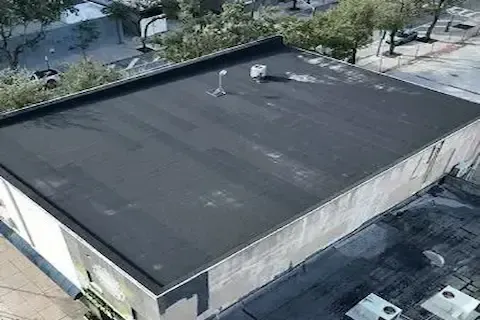
Full commercial flat roof replacement in Blaine including deck inspection, tapered insulation, and warranted TPO or EPDM membrane installation for Anoka County properties.

Commercial TPO roofing systems installed to manufacturer specification with heat-welded seams and full warranty coverage for Blaine MN and Anoka County commercial properties.

EPDM commercial roofing installation for Blaine MN properties — fully adhered, mechanically fastened, or ballasted configurations built to perform through Minnesota's freeze-thaw cycles.
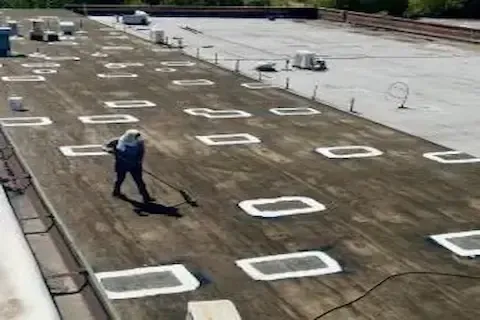
Commercial roof repair for Blaine MN and Anoka County flat roofs — seam failures, penetration flashings, storm damage patches, and membrane repairs with documented scope before any work begins.

Commercial storm damage roofing restoration in Blaine MN — emergency response, insurance documentation, temporary protection, and full membrane replacement for Anoka County properties.

Structured commercial roof maintenance programs for Blaine MN property managers — biannual inspections, pre-winter drain clearing, proactive sealant work, and written condition reports.

Modified bitumen roofing installation and reroof for Blaine MN commercial buildings — torch-applied multi-layer systems that deliver redundant waterproofing for Minnesota climates.

Commercial roof inspection services for Blaine MN and Anoka County — written condition reports with section-by-section ratings and documented photographs for capital planning and insurance.

Commercial roof coating services for Blaine MN flat roofs — silicone and acrylic applications that extend membrane life and qualify for Xcel Energy cool roof rebates in Minnesota.

New construction commercial roofing for Blaine MN building projects — full membrane specification, Anoka County permit management, and Minnesota Energy Code compliance from pre-bid through final inspection.
Frequently Asked Questions
Commercial Roofing can be complex, and we’re here to provide answers to common questions. Here are some frequently asked questions from our clients.
Frequently Asked Questions about Commercial Roofing Blaine MN
How long does a commercial flat roof last in Minnesota?
Most commercial flat roofs in Minnesota last 15 to 25 years depending on membrane type, installation quality, and how consistently the roof is inspected through freeze-thaw cycles and heavy snowfall seasons.
What is the best flat roof membrane for Blaine MN commercial buildings?
TPO is generally the top choice for new commercial flat roofs in Blaine and Anoka County. Its heat-welded seams, UV reflectivity, and performance through Minnesota freeze-thaw cycles make it the most reliable option for most commercial applications.
How often should a commercial roof be inspected in Minnesota?
Minnesota commercial property owners should schedule professional roof inspections twice a year — once before winter to identify vulnerabilities before ice loading, and once in spring to document any damage caused by ice damming or freeze-thaw membrane stress.
Do commercial roofing projects in Anoka County require a building permit?
Anoka County commercial roofing projects typically require a building permit issued through the city or county permitting office. Full replacements almost always require permits. We handle the permitting process on all qualifying projects as part of our service scope.
How do I document commercial storm damage for an insurance claim in MN?
Commercial hail damage claims in Minnesota must be documented thoroughly before an adjuster arrives. This means photos of impact marks on membrane, metal edging, and HVAC equipment. We provide professional storm damage assessments that meet Anoka County carrier documentation requirements.
Can a commercial roof coating extend the life of a flat roof in Blaine?
A commercial roof coating can extend flat roof life by 10 or more years at a fraction of replacement cost. Silicone and acrylic coatings qualify for Xcel Energy cool roof rebates in Minnesota, making them a highly cost-effective option for qualifying commercial properties in Blaine.
Need Commercial Roofing?
What Our Satisfied Clients Have to Say About Blaine Commercial Roofing
We pride ourselves on delivering great results and experiences for each client. Hear directly from home and business owners who’ve trusted us with their Commercial Roofing needs.

We manage three office buildings in Blaine and have worked with a lot of roofing contractors over the years. The difference here is they actually understand commercial flat roofs — TPO specifications, drainage slope requirements, Anoka County permitting. They replaced the membrane on our largest building and handled the whole permit process. No surprises, clean work.
Marcus T
After last spring's hail storm we had significant damage to our warehouse roof on the Highway 65 corridor. They came out within 24 hours, documented everything the insurance adjuster needed, and had a full TPO replacement scope ready before any other contractor even returned our call. The claim was approved and the job was done inside three weeks.
Sandra K
We had been getting quotes for replacing a modified bitumen roof on our Blaine commercial property that were all over the map. These guys inspected it, showed us exactly what sections needed replacement versus what could be maintained, and gave us a phased plan that fit our capital budget. That kind of honest assessment is rare in this industry.
Greg Halverson
The Trusted Commercial Roofing Expert Near You
Ready to hear more about expert services at Blaine Commercial Roofing?
Contact us today to receive a detailed, no-obligation quote.

Blaine & the Twin Cities metro
Monday-Friday: 9am-5pm, Saturday: 11am-3pm
